Why Does My Jaw Hurt?
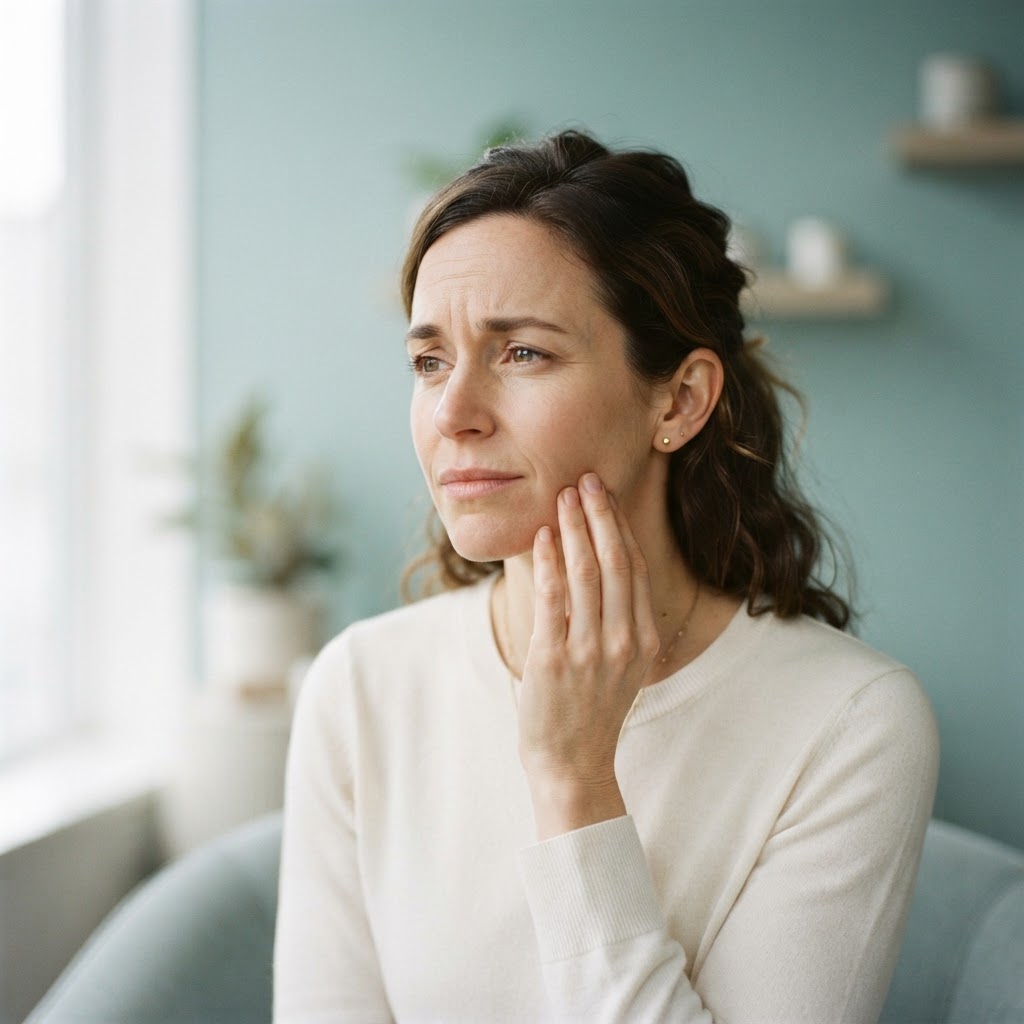
Jaw pain usually starts in the jaw joint, the muscles that move the jaw, or the neck. Here is how each is assessed and what conservative care may involve.
Overview
Jaw pain usually comes from one of three places: the temporomandibular joint (TMJ) itself, the muscles that move the jaw, or the neck and posture that influence how the jaw and its muscles work. In many people, more than one of these is involved at the same time — which is why jaw pain can feel different from one person to the next.
The TMJ is the hinge joint that connects your lower jaw to your skull, one on each side, just in front of the ear. It is one of the most used joints in the body: every time you speak, chew, swallow or yawn. Because it works together with the jaw muscles, the neck and your posture, symptoms can appear without any obvious injury or single cause.
Jaw pain can feel like a dull ache in the cheek or in front of the ear, a sharp pain when chewing, tenderness in the muscles at the side of the head, clicking or grinding sounds, an earache-like feeling with a normal ear, or a jaw that feels tired, stiff or difficult to open fully. None of these on its own tells you what is causing the pain — that is what an assessment is for.
Most jaw pain is not a sign of something dangerous, and many episodes settle. Some symptoms, however, should be checked promptly by a dentist or physician: a jaw that is locked open or closed, pain after a direct blow to the jaw or face, facial swelling, fever, new facial numbness, or jaw pain with difficulty swallowing or breathing.
Common Causes
- Jaw clenching or teeth grinding (bruxism), including during sleep
- Jaw muscle tension, spasm or trigger points
- Inflammation or arthritic change within the TMJ
- Disc displacement inside the joint (clicking, catching or locking)
- Neck joint dysfunction and posture that alter jaw muscle activity
- Prolonged or repetitive jaw use — gum chewing, wide yawns, long dental appointments
- Direct injury or trauma to the jaw or face
- Stress and disrupted sleep, which commonly increase daytime and night-time clenching
- Bite, tooth or appliance factors, which a dentist assesses
Symptoms
- Aching pain in the jaw, cheek or in front of the ear
- Pain or fatigue when chewing, talking or yawning
- Clicking, popping or grinding sounds from the joint
- Tenderness in the jaw and temple muscles
- Limited, uneven or deviating mouth opening
- A jaw that feels stiff, tired or locks
- Earache-like pain with no ear infection
- Headache or neck pain alongside jaw symptoms
Our Approach
Because jaw pain usually has more than one contributor, Dr. Shahab Entezami begins with a focused history and examination: how and when the pain started, what eases or aggravates it, how the jaw opens and closes, whether there is clicking, catching or locking, and how the jaw muscles, neck joints and posture behave together. This is a musculoskeletal assessment of jaw pain — it does not replace a dental examination. Where bite, tooth or appliance factors may be involved, care is co-managed with your dentist and findings are communicated back to them. Conservative management may include contemporary medical acupuncture for jaw and neck muscle trigger points, soft tissue and instrument-assisted soft tissue therapy, gentle manual therapy for the cervical spine, and education about jaw habits, daytime clenching and chewing. Progress is reviewed as you go, and care is adapted to your response. The appropriate approach depends on the individual assessment, and results and treatment needs vary.
Treatments Used
- Jaw & Neck Musculoskeletal Assessment
- Contemporary Medical Acupuncture (Jaw & Neck Muscles)
- Soft Tissue & Trigger Point Therapy
- Instrument Assisted Soft Tissue Therapy
- Gentle Cervical Spine Manual Therapy
- Jaw Habit, Clenching & Sleep Education
- Co-management with Your Dentist
Common Questions
Should I see a dentist or a chiropractor for jaw pain?
It depends on what is driving the pain, and often both are involved. A dentist assesses the teeth, bite, and appliance needs, and can rule out dental causes such as an abscess or a cracked tooth. A chiropractor assesses the joint mechanics, the jaw muscles and the neck, which very often contribute to jaw pain. Many people are co-managed: the dentist addresses dental factors while the musculoskeletal components are treated conservatively. If you are unsure, a dental examination first is a reasonable step.
Why does my jaw click, and is that a problem?
Clicking or popping is very common and, on its own, is not a sign of damage or a reason for treatment. Many people have clicking with no pain or loss of function. Clicking is worth assessing when it comes with pain, catching, locking, limited opening, or difficulty eating — because then the joint mechanics and the surrounding muscles are worth examining.
Can a chiropractor help with TMJ pain?
Chiropractors in Ontario are regulated health professionals who assess and manage musculoskeletal conditions, including the jaw joint and its muscles. Dr. Entezami does not present himself as a TMJ specialist and does not treat dental or orthodontic problems. What he can offer is an assessment of the joint, jaw muscles and neck, followed by conservative management where it is appropriate — which may help some patients. The appropriate approach depends on the individual assessment, and results and treatment needs vary.
How long does jaw pain usually take to settle?
It varies widely. Some people notice meaningful change within a few weeks, particularly when clenching habits, sleep and chewing loads change alongside treatment. Others need longer, especially where joint changes or longstanding habits are involved. Because results and treatment needs vary, your response is reviewed as care progresses and the plan is adjusted rather than fixed in advance.
What should I do right now if my jaw locks?
If your jaw is locked open or closed, or if jaw pain follows a blow to the face or comes with swelling, fever, or difficulty swallowing or breathing, seek prompt care from a dentist, physician or emergency service rather than waiting. If the jaw is stiff or painful but not locked, avoid hard chewing, gum and wide yawns for now, and arrange an assessment.